Supporting Defenders at the UN & What the UK Must Do Next
The 61st session of the Human Rights Council (23 February - 31 March 2026) took place in Geneva, Switzerland. Peace Brigades International (PBI) was present throughout, making formal interventions, co-organising side events, and supporting defenders to speak directly to the international community. It was also the first session in which the UK participated as a newly elected Council member. Here is what we saw, what we heard, and what we hope comes next.
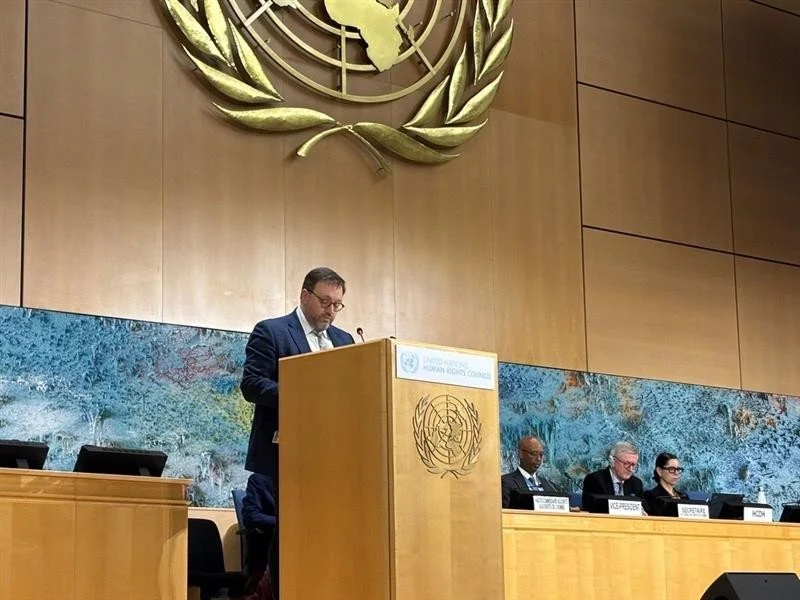
Chris Elmore MP, Minister for Multilateral, Human Rights, Latin America and the Caribbean, at the UN Human Rights Council High-Level Week
What the UK Said in Geneva
During High-Level Week, Minister for Human Rights Chris Elmore MP, who recently met Purépecha Indigenous human rights defender Claudia Ignacio Álvarez and West Papuan Indigenous human rights defender Lia Yewen, addressed the Council, describing human rights defenders as “ordinary people doing extraordinary things.” He announced a £2.5 million commitment to the Lighthouse Fund to support and protect those individuals, declaring that:
“The world is becoming more dangerous for [human rights defenders]. And we cannot allow that to continue.”
In December 2025, the UK announced the UK guiding principles on supporting human rights defenders, an update to the 2019 UK Support for Human Rights Defenders which was issued under the Conservative Government. PBI UK and other civil society organisations criticised the guiding principles, cautioning that several practical components and strong commitments were stripped from the previous guidance and that the guiding principles contrast with the UK's pledge to "Defend civic space and fundamental freedoms" as one of its four priorities for its seat on the UN Human Rights Council.
During this session, the Foreign, Commonwealth and Development Office (FCDO) announced allocations of the UK aid budget, which revealed severe cuts across the board. PBI UK echoes the concerns raised by Bond UK and other organisations in the sector about these allocations. Furthermore, it’s still unclear as to how the allocations will affect human rights and civic space funding more specifically, so our concern remains that cuts to UK aid will inevitably leave even more civil society organisations and human rights defenders exposed at a time of escalating global crises and urge the FCDO to ensure clarity on this as swiftly as possible.
While the UK’s commitments at the Human Rights Council were encouraging words, our work on the ground confirms daily that defenders face an increasingly dangerous environment, and that commitments made at the Palais des Nations must translate into sustained, concrete and accessible action.
An Increasingly Dangerous Context for human rights defenders
PBI made formal interventions on Colombia, Guatemala, Honduras, Nicaragua, housing rights, and the global situation of defenders. The outgoing Special Rapporteur on Human Rights Defenders, Mary Lawlor, documented at least 625 murders or disappearances of defenders and journalists in 2024, the highest figure on record, and described a widening crisis of funding cuts, repression, and shrinking civic space. Furthermore, 77% of defenders reported being affected by cuts to protection networks, psychosocial support, and legal assistance.
PBI’s interventions reflected challenging conditions on the ground:
In Colombia, 109 defenders were murdered between January and August 2025. PBI called for full implementation of the Law on Women Searchers and stronger state presence in rural areas most affected by armed conflict.
In Guatemala, over 4,500 attacks against defenders were recorded in the first nine months of 2025. PBI raised the historic ruling protecting community journalist Norma Sancir and called for dialogue mechanisms to resolve land conflicts affecting Indigenous communities.
In Honduras, defender killings rose from 7 in 2024 to 17 in 2025, with land and environmental defenders disproportionately affected. PBI called for full corporate accountability, compliance with the reparation plan for Berta Cáceres’ murder, and stronger protection for communities facing extractive industry pressure.
In Nicaragua, PBI documented nearly 200 cases of transnational repression - surveillance, harassment, and attacks targeting defenders in exile - and called on the international community to recognise this as a distinct and urgent dimension of the crisis.
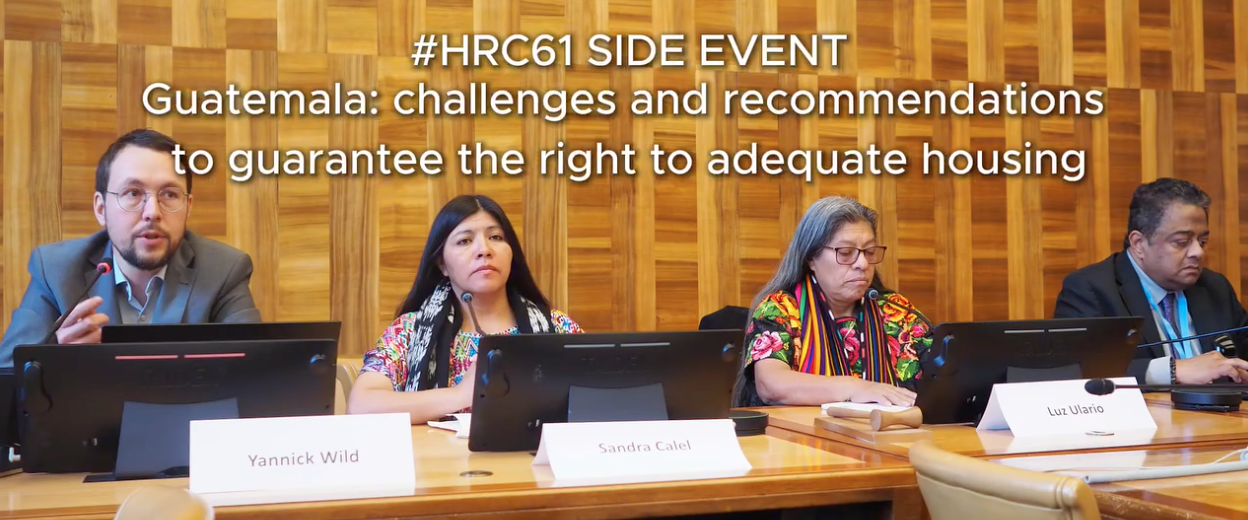
PBI co-organised side events on territorial violence in Colombia, housing rights in Guatemala, and arbitrary detention in Nicaragua. We supported Sandra Calel of UVOC and exiled Nicaraguan defender Salvador Marenco to speak at the international level. The defenders PBI supports are not statistics — they are people whose safety depends on international solidarity, and on governments like the UK following through on the commitments they make at international fora such as the UN.
The UK’s own declarations echoed PBI’s concerns. In its statement on Nicaragua, the UK highlighted the “alarming expansion of transnational repression” and gender-based crimes, and called on Managua to re-engage with the UN system. On Honduras, London called on the government to:
“Protect Indigenous Peoples and human rights defenders who work on environmental issues through legal reforms and effective enforcement, including safeguarding the right to free, prior and informed consent.”
This intervention is especially poignant in light of a recent fact-finding mission conducted by a group of international lawyers and supported by PBI which uncovered extensive territorial dispossession of Indigenous and campesino communities in Honduras.
Consequently, these statements reflect a welcome consistency from the UK on defender protection — specific, evidence-based, and attentive to the particular risks facing environmental and Indigenous advocates. This is the kind of engagement PBI hopes to see sustained throughout the UK’s HRC membership.
Business, Human Rights, and the UK’s Role
A significant theme across HRC61 was the link between corporate activity and violence against defenders. In PBI's intervention on Honduras, we highlighted that ten years after the murder of Berta Cáceres, foreign investment in extractive projects continues to contribute to violence against land and environmental defenders, and called for a national action plan on business and human rights with meaningful civil society participation.
Moreover, the Special Rapporteur on the Environment found that fossil fuel extraction contributes to displacement, pollution, and violence, disproportionately affecting Indigenous peoples, people of African descent, and peasant communities. With British corporate interests active in many of the countries where PBI works, the UK’s HRC seat offers a real opportunity to champion enforceable accountability standards, whilst further highlighting the need for a new Business, Human Rights and Environment Act to be enshrined in UK law.
What we Hope the UK will do next
Fund defenders, not just mechanisms. The £2.5 million Lighthouse Fund commitment is a welcome step, but funding must reach the grassroots protection networks that defenders themselves identify as most critical. That means flexible, multi-year support shaped by defenders' own priorities, and targeted at those facing the most acute risks, including environmental defenders and those subject to transnational repression.
Use the HRC seat consistently and ambitiously. The UK’s interventions on Honduras and Nicaragua at HRC61 were encouraging. We hope to see this level of specificity maintained — raising individual countries, naming patterns of abuse, and pushing for accountability, not just in public statements at the Council, but in the UK's bilateral diplomacy and its voting record over its three-year term. We also encourage the UK to not shy away from calling for justice and accountability in specific cases of attacks and threats against human rights defenders.
Champion the Special Rapporteur’s mandate and recommendations. The mandate of the Special Rapporteur on the situation of human rights defenders came up for renewal at this session, and Andrea Bolaños Vargas has been appointed as the new Special Rapporteur. London should actively support the continuation of the mandate, advocate for adequate resourcing, and, critically, demonstrate leadership by taking up the Rapporteur’s recommendations in its own foreign policy, including on funding for local protection networks and ending the criminalisation of civil society. We welcome Andrea Bolaños as the new Special Rapporteur and look forward to working with her during her time on the mandate to protect those who defend rights.