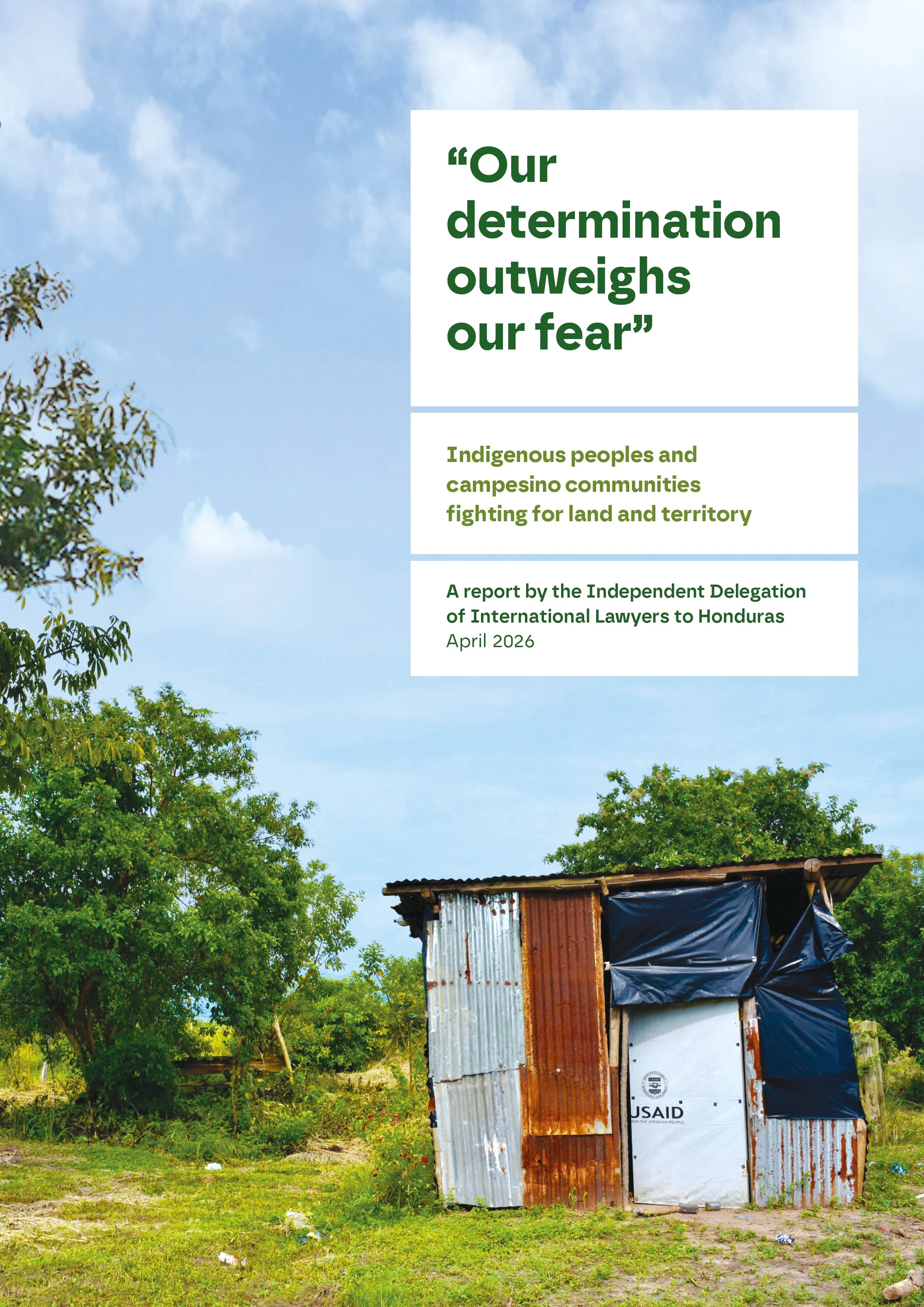
"Our Determination Outweighs Our Fear": Indigenous peoples and campesino communities fighting for land and territory in Honduras
30 April 2026
A new report presents the findings of an Independent Delegation of International Lawyers who conducted a fact-finding mission to Honduras in September 2025, examining the grave human rights situation facing Indigenous peoples and campesino communities struggling against violent land conflict.
The delegation travelled to the departments of Francisco Morazán, Comayagua, Cortés and Colón, meeting with Indigenous and campesino communities, social movements, legal representatives, state authorities, the Public Prosecutor's Office, the UN High Commissioner for Human Rights (OHCHR), and the diplomatic corps.
The report puts forward constructive proposals, from the perspective of international legal experts, for how Honduras can improve access to justice for all and meet its obligations under international human rights law.
The Independent Delegation of International Lawyers was invited to Honduras by the Bufete Justicia para los Pueblos and accompanied by PBI. The delegation was comprised of the following experts:
Isabel Madariaga Cuneo – Independent human rights consultant and expert on Indigenous peoples' rights (Chile)
Omar Gómez Trejo – Independent human rights and criminal justice expert (Mexico)
Daniel Cerqueira – Director of the Climate Justice and Human Rights programme at the Due Process of Law Foundation (Brazil)
Camila Zapata Besso – Human rights barrister at Doughty Street Chambers (UK and Colombia)
“Acts of violence, particularly the murders of Berta Cáceres and Juan López, reflect a systematic pattern of attacks against those who defend the land. The structures of power allow extractive and agro-industrial megaprojects to go ahead without taking the human cost into account.”
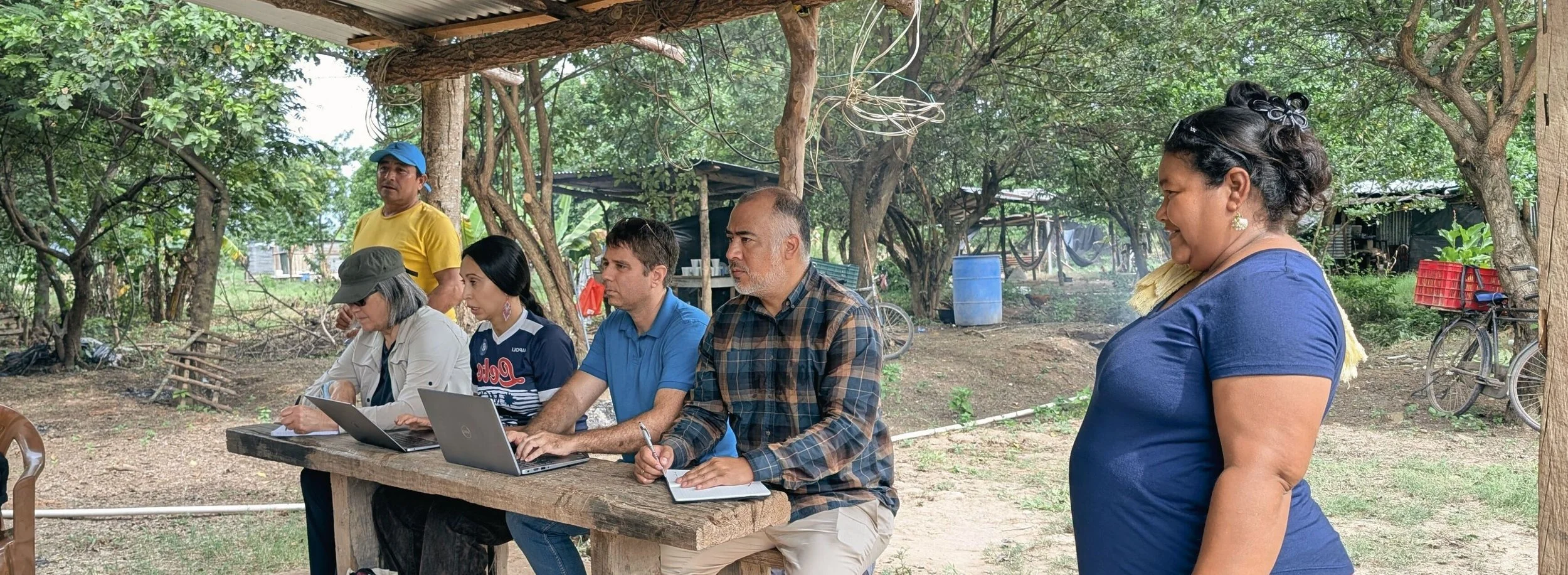
Photo: Delegates were invited by the CNTC to a community meeting in the “Base Campesina 17 de Junio” in El Progreso
Conclusions and Recommendations
The report concluded that agrarian conflicts in Honduras have historical causes that have been exacerbated by a structure in which the interests of agro-industrial and extractive companies, corruption, organised crime, and the complicity or acquiescence of state security structures converge.
The testimonies gathered by the delegation show that violence, criminalisation, and forced evictions are not isolated incidents, but rather components of a strategy that guarantees impunity for serious human rights violations and consolidates a development model that is contrary to the ways of life of the country’s Indigenous and campesino communities.
Based on accounts from several affected communities, meetings with state authorities, and analysis of statements by international organisations and publicly available information, the delegation identified patterns of serious and systematic human rights violations.
Physical and psychological violence is constantly used as a tool to intimidate, displace, and dismantle the defence of the environment, Indigenous territories, and campesino lands. The murder of leaders is a recurring method used to crush such resistance. The cases of Berta Cáceres (Intibucá), Juan López, Aly Domínguez, Jairo Bonilla (Guapinol), and Roger Alexis Castillo Fuentes (Bajo Aguán) are just the tip of the iceberg of this violence, that has claimed hundreds of lives.
Moreover, the delegates noted that the perpetrators and masterminds behind these crimes, who are often linked to powerful business interests and organised crime, are neither investigated nor punished, perpetuating a cycle of violence and impunity.
The report highlights that the Honduran justice system is being used to prosecute people who defend their land and territory. The criminal offence of “trespassing” (usurpación) has been systematically used against members of Indigenous and campesino communities and their leaders, who are often subjected to arbitrary criminal proceedings and prolonged precautionary measures that restrict their freedom and hinder their work to defend their land. This pattern has been exacerbated by the issuance of Decree 93-2021, which eliminates key procedural safeguards, such as the requirement that “violence or intimidation” be used to constitute the crime of trespassing.
“Honduras is one of the few countries in the region that relies on criminal proceedings as the primary means of resolving land ownership disputes, without any judicial oversight of the validity of the land titles on which the eviction of Indigenous and campesino communities is based. This practice contradicts its international human rights obligations.”
Institutional weakness and the absence of effective land ownership policies were noted as determining factors in agrarian conflict in Honduras and the lack of protection of the property rights of Indigenous, Garifuna and Afro-Honduran peoples over their ancestral lands has meant that third parties, often with the acquiescence of the State itself, have usurped them through irregularly obtained land titles, acts of corruption and violence. The structural causes of human rights violations against campesino communities and Indigenous and Garífuna peoples remain unchanged and have worsened in recent years. Legal certainty and the protection of their lands and territories are essential conditions for resolving this persistent rural conflict.
Therefore, the delegation recommends that the Honduran State:
Immediately repeals Decree 93-2021 and reform the Criminal Code and Code of Criminal Procedure to eliminate the concept of preventive evictions and prevent the arbitrary use of punitive power against Indigenous and campesino defenders.
Resolves inconsistencies in the records held by the National Agrarian Institute and the Land Registry Office through a national cadastral survey, in accordance with Honduras’ international commitments.
Establishes and effectively implement the Tripartite Truth Commission to investigate human rights violations in Bajo Aguán.
Monitors and regulates business activities to prevent human rights violations and environmental harm.
Implements the Special Jurisdiction for Land and Territory, ensuring that property disputes are resolved through agrarian or civil proceedings rather than criminal proceedings.
Fully and immediately complies with the rulings of the Inter-American Court of Human Rights.
Restructures the National Protection Mechanism to provide effective responses aimed at preventing violence against those who defend their land and natural resources.
Furthermore, the delegation recommends that the international community and multilateral banks:
Strengthen mechanisms to protect those who defend the rights of Indigenous and campesino communities;
Prioritise the issues raised in this report in political dialogue and cooperation programmes with the Honduran State; and
Establish mandatory human rights and environmental due diligence mechanisms for all companies with investments, direct operations and supply chains links in Honduras.
Download the full report in English here
Download the full report in Spanish here
Download the press release in English here
Download the press release in Spanish here
PBI UK provided support to the Independent Delegation of International Lawyers and, for many years, has provided various forms of security and advocacy support to human rights defenders in Honduras. To help PBI provide legal support to more communities in more countries, please donate here