In Conversation with Kenia Oliva and Dunia Sánchez
Human Rights Defenders from Honduras
Interview by Matvej Dubianskij
In April, PBI UK welcomed Kenia Oliva and Dunia Sánchez to London for the launch of the report, “Our Determination Outweighs Our Fear”: Agrarian conflict and the criminalisation of Indigenous and campesino communities. Based on a visit to Honduras in September 2025 by the Independent International Delegation of Lawyers, the report documents the risks faced by defenders of land, territory, and environment in Honduras. We spoke to Kenia and Dunia to discuss their work as human rights defenders, the struggles of their movement against impunity for violence against defenders, and the impact of their advocacy in the UK.
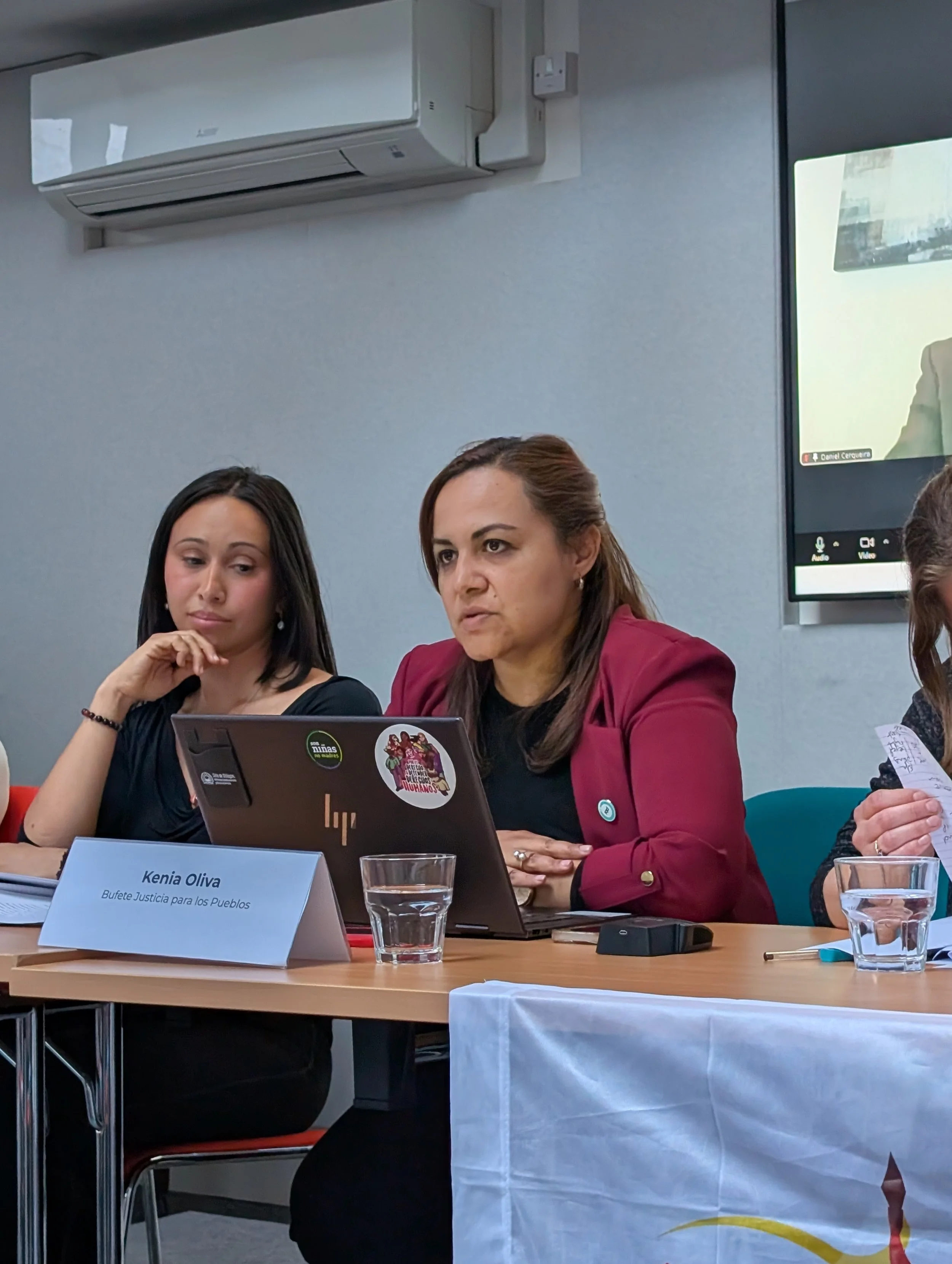
Kenia Oliva, co-founder of Bufete Justicia para los Pueblos, speaking at the report launch
PBI: Can you please tell us a little bit about you, your work, the communities you represent, and why you decided to come to London this week?
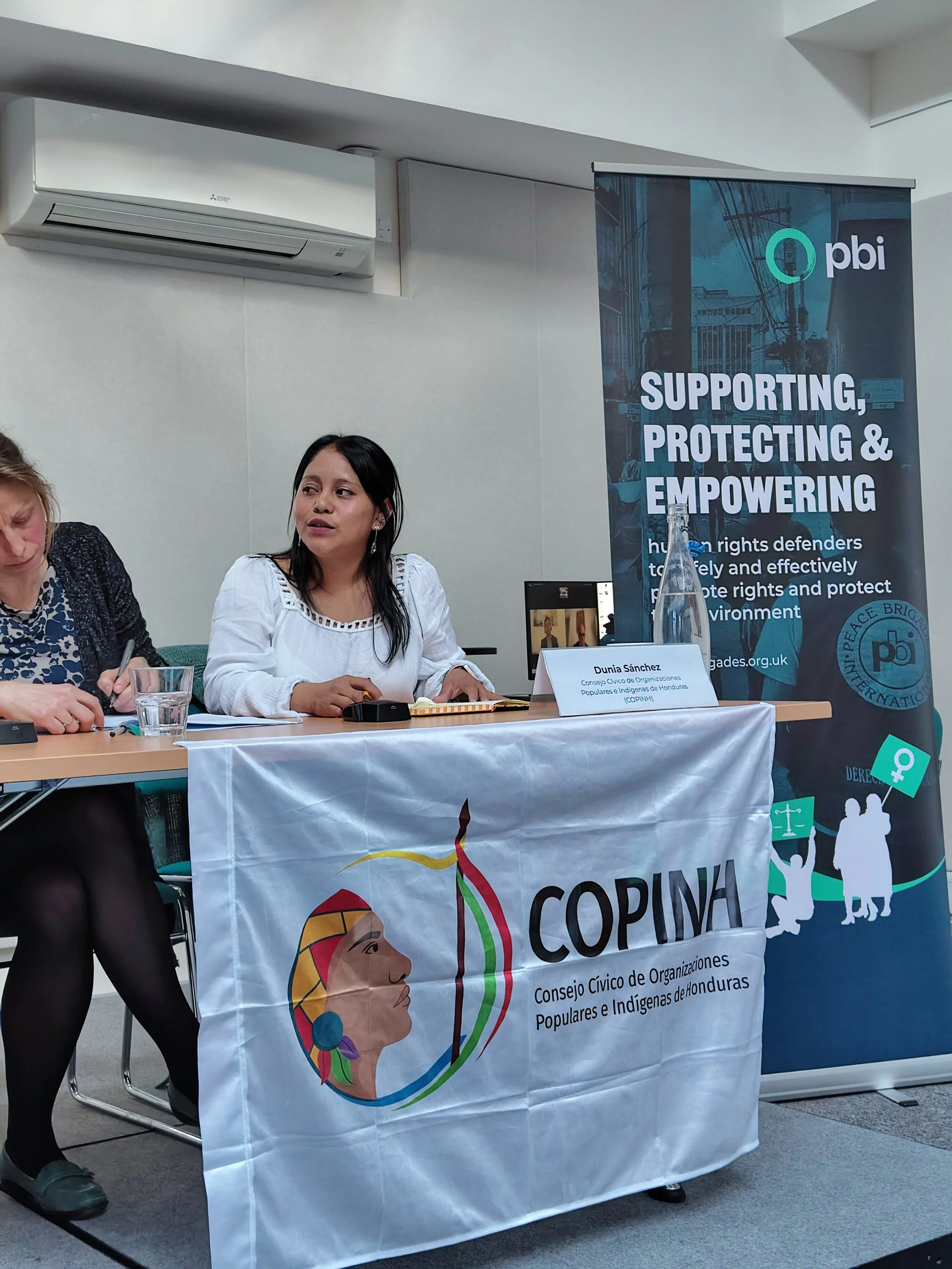
Dunia Sánchez, Lenca Indigenous human rights defender and member of COPINH, speaking at the report launch
Kenia: I’m Kenia Oliva. I’m the co-founder of the law firm Justicia para los Pueblos. We are a group of lawyers who decided that we wanted to get together to defend land and environmental defenders in particular. We also take cases of general public interest relating to things like freedom of expression and other topics, like worker’s rights. As independent lawyers, we’ve worked for a long time on these sorts of cases, but in 2020 is when we decided to co-found the firm together. We’ve also worked on issues of corruption in public life, issues to do with the rights of domestic workers, but we really do feel that in Honduras the main and biggest issue is around land and environmental defenders, because they are so criminalised for what they do. This includes, particularly, Indigenous people, campesino communities, and, more broadly, environmental defenders. This is because the criminalisation of these defenders arises particularly because of the laws that are used to attack defenders. They are criminally prosecuted for the work that they do, they’re displaced, and the laws are used by the people working for the state to stigmatise environmental defenders, launch smear campaigns against them, and generally undermine or try to dismantle their struggles.
Dunia: I’m Dunia Maheli Sánchez, and I’m from the Civil Council of Grassroots and Indigenous Organisations in Honduras (COPINH), which is a Honduran organisation. COPINH is an organisation that accompanies the struggles of land and environmental defenders, particularly in relation to the protection of water, land, and forests. We also seek justice for the violations that we experience as the Lenca people. I’m from a Lenca community called Río Blanco, which is a community that forms part of COPINH, as well as other communities, as a community-based organisation. As I got more involved in COPINH, I really began to understand the importance of defending the environment and the territories, which was a learning process for me. And so I’ve been very involved in the organisation for some time now. The organisation mainly accompanies cases and lawsuits in relation to access to land for the Lenca people, and it’s always this access to land, this struggle, and the fight for decent housing, for the right to cultivate, the right to food that we fight for. We also accompany cases in the context of access to land, such as community cases relating to land titles, because many of the communities, while they have ancestral titles, don't have the official paper land deeds that name the communities on those deeds.
PBI: In their report, the Independent Delegation of International Lawyers has documented a pattern of killings, criminalisation, and forced evictions against land and environmental defenders, specifically for Indigenous and campesino communities. What do these findings mean to you personally and to the communities you work with?
Kenia: So for us, the evidence in the report is so important because of the patterns that it demonstrates and because the way it is recorded through independent lawyers can help us to demand justice in the cases that we’re working on. It’s also important to try to stop these patterns from repeating themselves.
In Honduras, between 2022 to 2025, 35 land and environmental defenders were killed. It is important to name these people and to be able to demand that the state investigate these killings. We need these issues to be documented in order to prove that they happened, so having this report from independent and international lawyers gives us further evidence that we can use to force the Honduran state to move forward with investigating the cases. It’s extra evidence in our favour.
It’s also important for our self-care. If we know these patterns exist, if we’ve recorded these patterns, then we are better able to make decisions about when a human rights defender needs to take a step back, lower their profile, and leave their area at a time to ensure their safety. Because, if not, then people will die.
We need to continue to record these cases and patterns, write them down, and make sure that we have evidence for them, because otherwise the state either says that it doesn’t happen, or that it’s not related to their work. If we don’t have records, then the state or the prosecution services often try to just put these deaths down to organised crime or, if they’re women human rights defenders, they just say that they’re crimes of passion, which they’re not. This report gives weight to our claims and will support our fight for justice and our fight against impunity.
Dunia: The report is incredibly important, because the Delegation has been able to see and witness firsthand the violations that human rights, environmental and territory defenders are facing, and the particular impacts on Indigenous peoples and campesino communities. The fact that they have seen these violations with their own eyes and documented the facts in a report provides support to our claims and to the difficulties that we face in our struggles.
Issues in relation to access to land and in defense of our territory are commonplace in Honduras, and they have been able to see how the Honduran state does nothing to stop it. Having international and independent lawyers demonstrate and set out the violations that they have seen and make recommendations to the Honduran state provides us with a tool that we can use to pressure the Honduran state to implement these recommendations, to analyse what is going on, and to try to put mechanisms in place to prevent these things from repeating.
It is an extra level of surveillance on the Honduran state. For us, as organisations, as environmental and land defenders, the report provides support to our struggles and puts pressure on the Honduran state to prevent these things from happening.
The report is also an important tool because of the way that they documented the criminalisations and the violations that different communities face. The report can now be used to stop the killings that have been so prevalent and to seek justice in the cases of Berta Cáceres and Juan López and others.
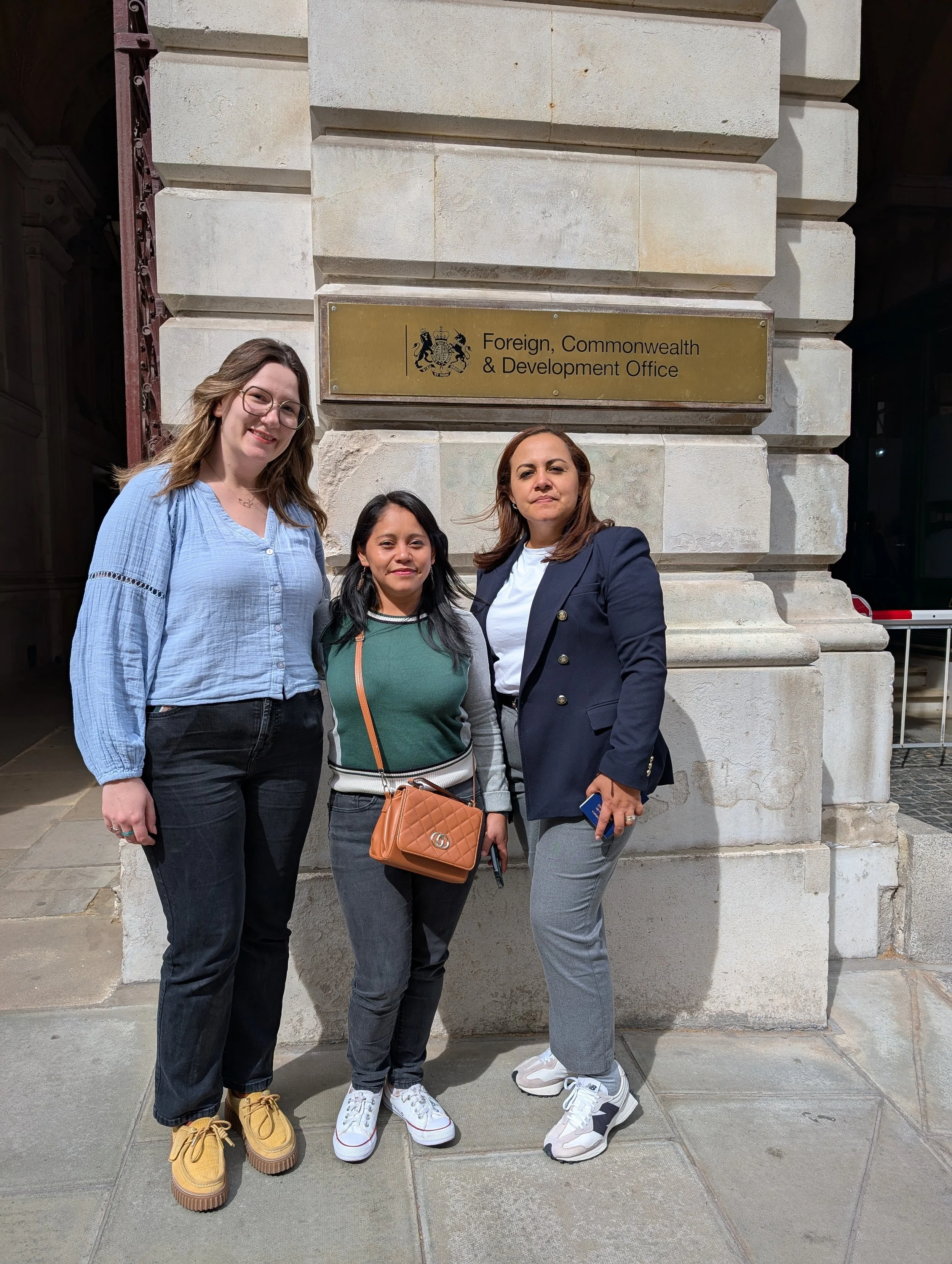
Christina Challis (PBI UK), Dunia Sánchez, and Kenia Oliva at the UK’s Foreign, Commonwealth & Development Office (FCDO)
PBI: Peace Brigades International has been accompanying defenders and communities in Honduras for many years. So what has that presence meant in practice for you and your organisations and communities?
Kenia: PBI is extremely important because they open doors. When PBI does advocacy, this can lead to us being able to have meetings with civil servants and the authorities that we otherwise would not have been able to have. They also accompany us in things like in trials or to court hearings, and we believe that they have an important, dissuasive effect there, either dissuading judges and other legal officials from corrupt acts or simply from negligence. When PBI observers are there, these actors seem to care more about doing the job properly. When PBI accompanies us and visits communities, their green jackets act as a sort of shield, which also has a dissuasive effect because their international presence means that somebody’s watching.
Fortunately, we have never been attacked when we are with PBI out in the field, so we believe that their presence is extremely important in a context that’s so adverse and so violent for human rights defenders. We believe it’s important for PBI to continue having a presence in Honduras because of their recognition there. There have been times when the authorities have tried to speak out against PBI and tried to sully their name, but this means that everybody raises their voice against the authorities, because all the organisations feel so strongly about that. PBI opens up a path for us, but they also protect us in the work that they do.
Dunia: The work that PBI does is extremely important. To give one example, they’ve helped us to develop a register for incidents and give us training on how to record incidents that happen, how to record and classify the different attacks or different incidents according to the level of severity. That’s really important for us to understand how to measure the level of attacks that we’re facing and how to face up to that. They have also given us specific training on both digital and physical security. What we find is sometimes there are incidents and we’re not sure how to record them, and so in the training they really helped us to understand what is an incident and the importance of recording absolutely everything, because then you can try to reduce these incidents, rather than letting things get out of control, thereby keeping exposure to a minimum.
PBI also accompanies us at events; these can be events of up to 600 to 800 people, either at peaceful protests or anniversaries, and that’s extremely important because having PBI there means that the authorities can see that there, again, is this international eye. The authorities then feel like they can’t attack or do anything against us. So they protect us in our space. They stop the authorities in their attacks against us. PBI is also incredibly important because they reduce the oppressive activities of the authorities.
PBI’s attendance at court hearings has been essential. In Honduras it’s not commonplace to have everybody watching a trial or a hearing, and often they’ll try to prevent you from going in, particularly if you’re not dressed right or anything like that. PBI has done advocacy and has fought to ensure that affected communities can actually be inside the courtroom when a hearing is happening. The work that PBI does is absolutely essential because we live in such a critical situation, and without them, it wouldn’t be the same.
PBI: So, this week, you’re meeting with members of Parliament, government officials, lawyers, and civil society organisations alongside PBI UK. What is one thing you want them to understand most about the situation in Honduras that they cannot learn from the report alone?
Kenia: Besides the report and its importance, meeting with these stakeholders is an opportunity to try to push the UK government to question the Honduran government and to better understand the things that they can do here in London. In talking to the representatives from the FCDO in relation to what the embassy in Guatemala that also serves Honduras can do, we urged that they must pressure the Honduran government about the importance of strengthening the National Protection Mechanism for human rights defenders. There may be steps that the UK government could take through that route.
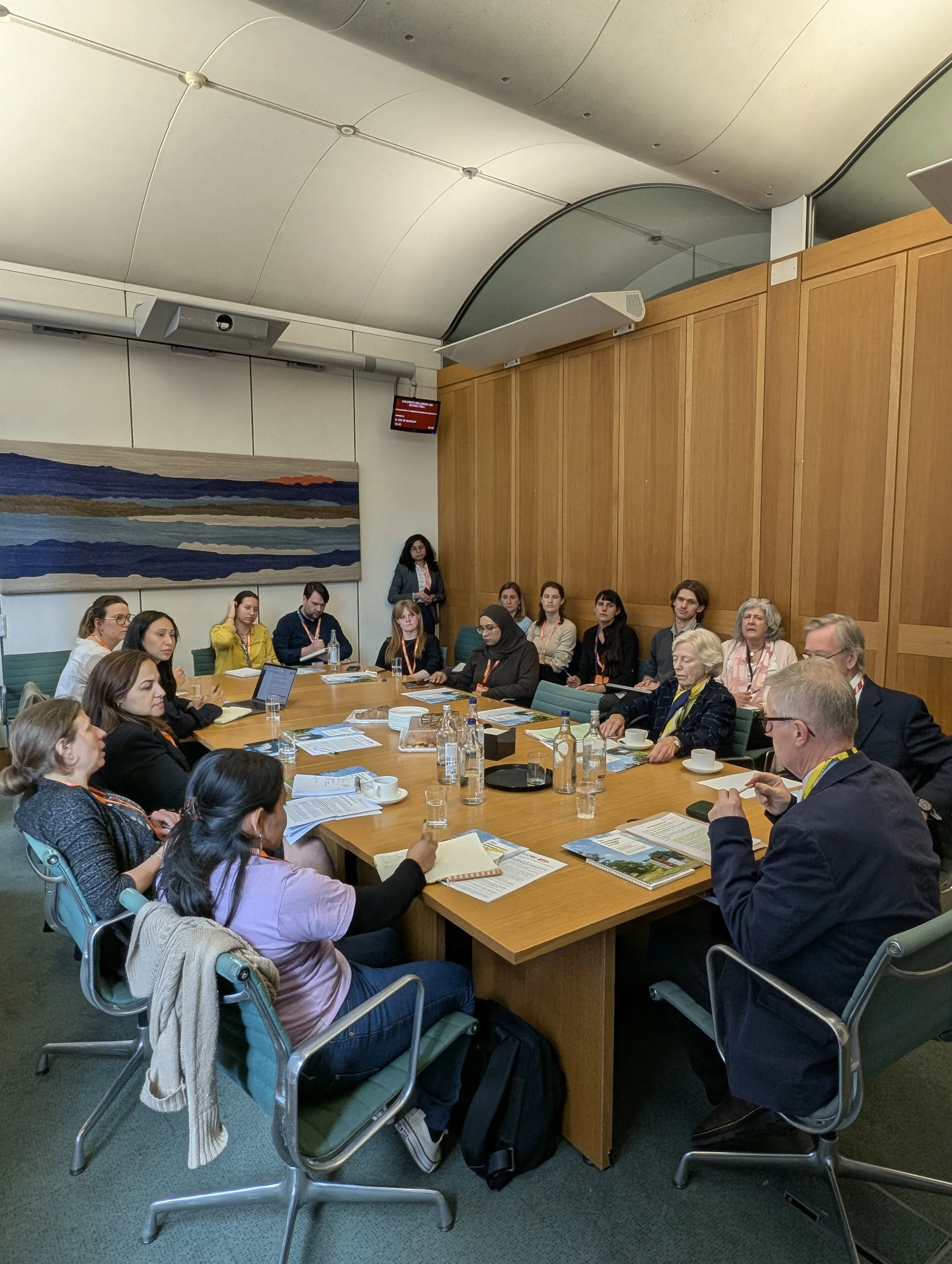
Kenia, Dunia, and other civil society representatives at the parliamentary roundtable chaired by Brendan O’Hara MP
We’ve been talking about the importance of the different public actions the lawyers and the other organisations that we’ve met can take to call for the respect of human rights defenders and their work, to prevent the criminalisation of their work, to repeal decree 93-2021, and to provide access to land to Indigenous peoples and campesino communities.
The meetings we’re having are so important because we need outside support for our calls. If it’s just us, nationally, calling for these things, then the authorities tend to try to shut us up, to block us, or to just ignore us. So international support is a way to make the Honduran state respond and to actually elicit positive movement. For me, this would be a real positive and the success of this tour, should these things come about.
Dunia: For COPINH, this tour has been so important to be able to speak about the situation of land and environmental defenders, and to really explain exactly what violations of our rights we face as Lenca people, as people who defend land and life. So many have been killed as a result of this work, including Berta Cáceres, the founder and coordinator of COPINH, for whom we’ve been seeking justice for ten years now.
It’s also been extremely important to raise the profile of the report that came out last year about Berta Cáceres’ case by an interdisciplinary experts group. Their report goes into great detail about all of the money that was moved around and the direct way these funds were diverted away from the development project into the persecution and final killing of Berta. They make concrete recommendations, so it’s been extremely important to speak to stakeholders here in the UK and highlight the recommendations that the report raised, raise the profile of the report, and to encourage parliamentarians and other people to speak to the Honduran state and to pressure them to re-affirm the findings of the report and to act on the basis of those recommendations.
PBI: We’ve touched upon this already, but is there anything else you want to add in terms of concrete steps that either the international community or the UK government can take to better protect Indigenous and campesino communities in Honduras?
Kenia: I think what’s key is to continue to follow up, not only with the civil servants and parliamentarians we’ve spoken to, to try to get them to do the things that they’ve promised to do, but also to maintain more open relations and to keep talking to them—the same with the different organisations based in the UK that we have been speaking to. This will help to keep Honduras on people’s minds, to keep the advocacy going, but also, there are so many things they can do to support local civil society, such as open pathways to accessible funds.
Everybody is facing cuts. This is something that is on everybody’s lips, and this is also something that is impacting our work. There are cuts to things relating to land defense, to Indigenous people, to human rights, and this is extremely dangerous. For us on the ground, it’s even harder. At the moment, we’re often faced with the problem that we can’t actually get to court hearings when they’re outside the city—they’re in rural places far away, and we literally don’t have the money to travel. Organisations that we accompany are also facing the same issue. Sometimes in the case of hearings we’re able to do them online, but that’s not always possible. We need resources to be able to keep working.
It’s so important to keep the channels open with the various stakeholders and organisations that we’ve spoken with, to coordinate efforts to help us to be able to continue working and doing the things that we do.
Dunia: Kenia’s already mentioned various important points, but it’s also important to do lots of follow-up advocacy, particularly in relation to the report by the Independent Delegation of International Lawyers. The report now needs to be presented to the Honduran state to add extra pressure on authorities to respond to the Delegation’s recommendations. The British Embassy in Guatemala that also covers Honduras must support the Delegation’s findings and recommendations, but also those by the group of independent experts on the Berta Cáceres case, because at the moment, the Honduran state is refusing to recognise the validity of that report and the recommendations.
There are so many other cases that are very similar to Berta’s that have just been left completely with no justice served, for lack of funding, for lack of coordination, and for various other reasons, and that’s why the Delegation’s report is so key to be able to urge action from the Honduran state and call for a view that this problem is much broader than that, and to be able to open up access to justice for others.
Call to Action
If this interview inspired you to support human rights defenders like Kenia and Dunia, there are several ways you can contribute to the cause:
Read and share the report by the Independent Delegation of International Lawyers
Take a few minutes to write to your MP to ensure the UK government’s support for human rights defenders like Kenia and Dunia
Donate to PBI UK to support our advocacy and protective accompaniment for human rights defenders at risk, and sign up to PBI UK’s quarterly newsletter to stay in the loop
Consider volunteering in the field as part of PBI’s protective accompaniment work